Black Youth Work in London - Equity, Power and the Case for Collective Action
Black-led youth organisations in London are preventing harm daily — but funding systems built on short-term cycles, narrow metrics, and trauma narratives are starving the very work that keeps communities safe. This report makes the case for why that has to change.
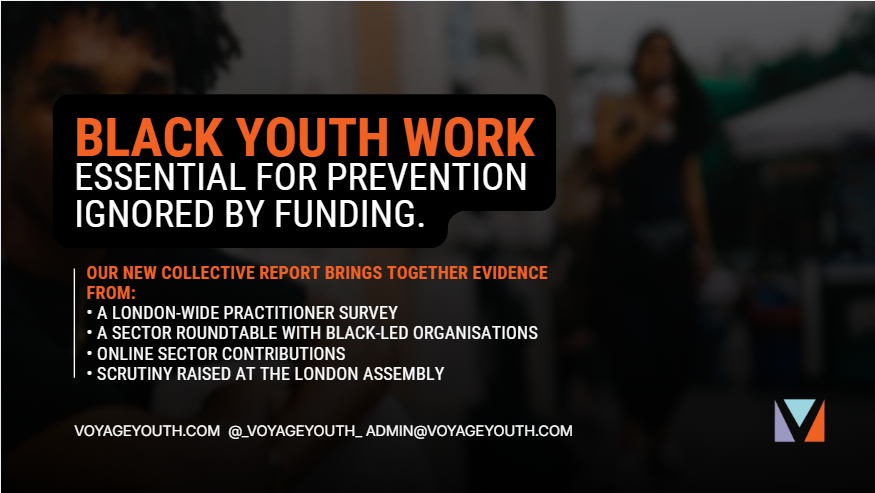
Black Youth Work in London Is Holding Back the Tide — And Being Left to Drown
A new report exposes how funding systems are undermining the very organisations preventing harm in our communities
Black-led youth work in London is in crisis — not because it isn't working, but because the systems designed to fund prevention are actively working against it.
That's the central finding of a new collective report, Black Youth Work in London: Equity, Power and the Case for Collective Action, authored by Paul Anderson MBE, CEO of Voyage Youth Hackney. The report draws on two in-person gatherings, a sector-wide survey, online contributions from over 7,000 professionals, and formal scrutiny at the London Assembly — including a question put directly to the Mayor on 20 November 2025.
The same message came through every single channel: Black youth work is essential to prevention, yet structurally undervalued by the funding and commissioning systems that are supposed to support it.
The problem with how we measure impact
Black youth workers don't just work with young people. They work with families, households, and whole community networks — because that's where risk, protection and belonging are actually shaped. Practitioners call it "360° practice." Funders don't fund it.
Instead, commissioning frameworks focus on individual outputs and short-term statistics, missing the deeper relational and intergenerational work that prevents harm before it becomes visible. As one practitioner put it bluntly: "We're not doing data capture — we are dabbing blood."
Performing trauma to get funded
Perhaps the most damning finding is what organisations are being forced to do just to access money. Funding applications routinely demand that organisations narrate violence and crisis to prove their need — pushing Black-led groups toward deficit storytelling rather than recognising the preventive work that stops harm happening in the first place.
"They are looking for the 'worst, baddest gangsters' — but we want to prevent that," one roundtable participant said.
Eighty percent of survey respondents said they were not confident their ideas were protected when submitted in applications — raising serious concerns about community knowledge being harvested without credit or compensation.
One to three years is not enough
The report is unambiguous on funding timescales. Prevention work operates on the timescale of years and generations. London's funding cycles operate on one to three years — often tied to political cycles and media attention following high-profile incidents.
The sector's view: funding should run "more like 12 or 20 years, not 1 year." Instead, organisations spend enormous energy hunting for the next grant, reassembling teams, and restructuring delivery — time that should be spent with young people and their families.
Who really controls the agenda
Money flowing through councils and intermediaries is reshaping who leads youth work in London. When commissioning favours organisations with bid-writing infrastructure over those with cultural reach and long-term community trust, Black-led organisations are pushed into becoming low-level subcontractors rather than strategy-setters.
"Police dictate the agenda, councils get the money," one participant observed.
What needs to change
The report calls for five institutional shifts: multi-year stable funding for prevention; evaluation models that recognise family and community-level impact; genuine transparency and meaningful feedback from funders; protection of intellectual property submitted in bids; and equity by design in decision-making.
It also calls on the sector itself to act — forming a collective consortium or alliance capable of coordinating pressure, responding to budget moments, and sustaining demands until outcomes actually shift. Because as the report notes, a one-off consultation will do very little without structural follow-through.
Read the full report
Click the button below!

