
Voyage Voices
Black Youth Work in London: Equity, Power and the Case for Collective Action
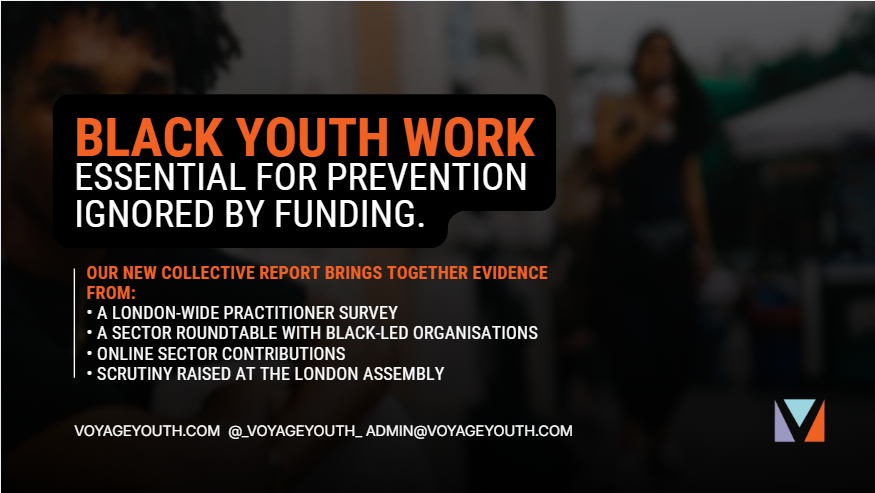
Black Youth Work in LondonEquity, Power and the Case for Collective Action
A collective report informed by two gatherings, a sector survey, online contributions, and London Assembly scrutiny (Oct–Nov 2025)
Author - Paul Anderson MBE CEO Voyage Youth Hackney
Executive summary
This report consolidates what Black-led youth organisations and practitioners have been thinking and saying consistently and across multiple spaces about the systemic barriers shaping youth funding in London. Our report brings together evidence from: (1) two related in-person gatherings (including the 15 October 2025 roundtable), (2) the Black Youth Worker survey (3) online sector contributions gathered via LinkedIn, and (4) London Assembly scrutiny action led by Zoe Garbett, including a question tabled at Mayor's Question Time on 20 November 2025 and a follow-up letter placed on record.
Across these evidence streams, the same message appears with striking consistency - Black youth work is essential to prevention, yet structurally undervalued by funding and commissioning systems. Current approaches favour short-term cycles, narrow metrics and organisations with the capacity to fit commissioning templates often at the expense of community-embedded, relational, preventative practice.
Participants also emphasised that Black youth work is not limited to the individual young person: it frequently involves families, carers, and community networks. The system's limited recognition of this "360° practice" contributes directly to the erosion of Black-led provision, diminishing who is funded, who leads youth work, and what forms of prevention are considered legitimate.
The report concludes that political representation is helpful but insufficient. The sector requires a collective voice and coordinated platform capable of sustained pressure particularly in relation to annual budget allocations, MOPAC/VRU commissioning, and borough-level funding pathways.
1) How this report came into being: a collective process, not a single-author agenda
This work developed through a deliberate effort to avoid one organisation, one political office, or one individual shaping the agenda alone.
The process began with shared concerns raised in Hackney-based conversations about reduced opportunity and narrowing funding pathways for Black-led youth work. Those concerns converged with broader London-wide frustration about how local government and Mayor-related funding is accessed, evaluated and ultimately awarded. The decision was made to build a collective evidence base using three channels:
- A practitioner survey (to gather patterns at scale)
- A roundtable conversation (to surface depth, nuance, and lived complexity)
- Online contributions via LinkedIn (to include voices beyond those able to attend meetings)
Zoe Garbett (London Assembly Member) played a key accountability role: she worked with practitioners to shape an agenda capable of scrutiny, requested survey headlines in advance and set out a clear pathway for how evidence would be used raising the issue with the Mayor at Mayor's Question Time on 20 November 2025 and following up in writing for the public record.
Importantly, the process also included internal feedback about what political scrutiny can and cannot do. As one academic participant later observed, while appreciative of Zoe's efforts, a one-off consultation "will do very little" without ongoing coordination and structural follow-through. That critique helped shift the work from "a moment" toward a sustained collective strategy.
2) Who took part - Roundtable participants (organisations only)
The 15 October 2025 roundtable brought together a representative set of Black-led and community-rooted organisations working across prevention, leadership development, community safety and family support. The organisations represented were:
- Account Hackney
- ACE Education Network
- Black Curriculum
- Black Men's Consortium's Mental Health
- Change in Youth
- Eastside Young Leaders Academy (EYLA)
- HEBE Foundation
- Juvenis
- May Project Garden
- Mitchfly Barbers
- NYCC Youth Community Connections
- Perminccic
- Rising Tide
- The Cribb
- Voyage Youth
- Wickers Charity
The meeting also included an academic participant and a further education perspective, which strengthened the discussion by bridging frontline practice, research insight and system-level analysis.
3) Evidence base and methodology - What sources were used and why
This report intentionally combines qualitative and quantitative inputs:
- Roundtable notes (15 Oct 2025) capturing themes, direct statements, and proposed actions.
- Survey findings (used as both headline statistics and open-ended testimony).
- LinkedIn post analytics and resulting engagement, used to evidence that the agenda resonated beyond the room.
- Mayor's Question Time (20 Nov 2025) and the follow-up letter summarising the evidence and recommendations, which creates a formal record and accountability pathway.
This approach matters for credibility - it ensures the report is not built on a single meeting, a single political question, or a single narrative frame.
4) Finding 1 - Black youth work is a 360° practice, but funding systems treat it as "individual intervention"
Across both in-person discussion and online contributions, practitioners described Black youth work as fundamentally deep, relational and intergenerational. The work frequently extends beyond direct youth engagement into family systems, households and wider community networks precisely because this is where risk, protection and belonging are shaped.
This came through in the roundtable notes as a direct critique of how funders define "impact": the system tends to focus on "individuals," not "family work / depth of work / long lasting work."
The policy implication is significant. If funding criteria and evaluation frameworks do not recognise family and community-level outcomes, they will reliably underfund the very practices most associated with prevention especially those delivered by Black-led organisations with deep community trust and legitimacy.
This mismatch also fuels a broader misrecognition: Black youth work is regularly relied upon to stabilise communities, yet is treated as "supplementary" rather than specialist and necessary.
5) Finding 2 - The application culture rewards trauma narratives and undervalues prevention
One of the most repeated and emotionally charged themes was how funding applications compel organisations to perform trauma. Practitioners described being asked to "bare your soul," repeatedly narrating violence to demonstrate need.
The roundtable notes captured this vividly -
"They are looking for the 'worst, baddest gangsters', but we want to prevent that."
This is not simply a complaint about language or form design; it is a systemic critique of deficit-based grant making. The model pushes organisations toward crisis storytelling rather than recognising preventive work that stops harm before it becomes visible.
Practitioners also raised concerns about trust and protection of ideas. One participant noted that applications involve high disclosure but low IP protection: "we bare our soul in applicants, no protections in what we submit."
That concern maps directly onto the formal survey statistics later shared in Zoe's letter: 80% reported they were not confident their ideas were protected and would not be reused without consent.
6) Finding 3 - Metrics are not the problem; narrow metrics are
Participants did not reject accountability. They rejected an accountability model that does not understand the problem it claims to measure.
The roundtable notes record a consistent tension: funders want metrics to prove value for money but "don't fully understand the problem," and the sector cannot "get prevention with the current model funders use."
This critique goes beyond discomfort; it points to misalignment between commissioning tools and real-world prevention.
The notes also capture the difference between administrative visibility and frontline reality: "We're not doing data capture we are dabbing blood."
For policy specialists and academics, this should be read as a methodological warning: systems that measure what is easiest to count will rarely measure what is most important to change.
Zoe's letter to the Mayor reinforces the same point: while metrics are understandable for public accountability, the long-term value of deep practice is harder to quantify and should be valued in new ways.
7) Finding 4 - Short-term funding cycles actively undermine long-term prevention
A consistent message across the roundtable and Zoe's subsequent letter was that London's youth funding is structurally short-term (one to three years), while the problem is structurally long-term.
The roundtable "headlines" state it plainly: the sector needs funding over a far longer timescale "more like 12 or 20 years, not 1 year and certainly not linked political cycles." Often abused by those seeking higher office.
Participants also noted how high-profile cases can trigger short-term injections of money, but these fade after media attention moves on.
Zoe's letter echoes this pattern: organisations described short bursts of attention after major incidents, followed by withdrawal, leaving instability that undermines staff retention, programme continuity, and community trust.
The practical outcome is predictable: organisations spend disproportionate time "hunting" for funding, completing paperwork and reassembling business plans, restructuring delivery teams and at times reforming new charitable entities using time that should be spent with young people and their families.
8) Finding 5 - Funding pathways (borough + MOPAC/VRU) shape who leads youth work, not just who delivers it
Participants repeatedly described how money flows through intermediaries in ways that dilute community influence and can reinforce inequity.
The roundtable notes describe emergency or post-crisis funding flowing through councils in small amounts, described as "a bit of an insult," alongside the sharper political observation: "Police dictate the agenda, councils get the money."
Participants also raised concerns about local-level extraction: "Hackney stealing the ideas of local units."
Taken together with survey concerns about IP and idea protection, the report identifies a pattern: community knowledge is regularly harvested, yet community infrastructure is rarely secured.
This matters for who leads youth provision. When commissioning and procurement favour organisations with bid-writing capacity over those with cultural reach and long-term community trust, it reshapes leadership: Black-led organisations become low level subcontractors rather than strategy-setters and innovators of good practice models.
9) Online contributions - what LinkedIn added and the numeric evidence
The online strand was designed as a deliberate inclusion mechanism: many practitioners cannot attend evening meetings or formal roundtables, and many voices exist outside London Assembly rooms. Email follow up and online engagement enabled the agenda to be shaped by a wider "room."
LinkedIn analytics (post published Oct 10, 2025)
The post analytics show substantial reach and interaction, which supports the claim that this agenda resonated beyond the roundtable:
- Impressions: 11,790
- Members reached: 7,317
- Reactions: 300
- Comments: 47
- Reposts: 58
- Sends: 14
- Saves: 8
- Link visits: 65 (to the survey link)
- Profile viewers from the post: 77
- Followers gained: 12
These figures matter in two ways. First, they show the conversation had a significant professional audience. Second, the 65 tracked link visits demonstrate that online engagement likely contributed to evidence gathering, complementing the in-person meeting and survey pathway.
Who engaged (demographics snapshot)
The top demographics also reinforce that the post reached decision-adjacent audiences:
- Job titles (top): Founder (4.5%), CEO (3.0%), Co-Founder (1.5%), Project Manager (1.3%), Board Member (1.1%)
- Location: London Area (56.9%) overwhelmingly, with additional UK city regions represented
- Company size (top segments): 1–10 employees (16.2%), 11–50 (15.6%), 1001–5000 (13.0%), 10,001+ (10.5%), 51–200 (9.9%)
In other words: the online contributions were not "noise." They reflected engagement from founders, CEOs, board members and staff across small grassroots entities and larger institutions exactly the right mix needed for a credible policy-facing conversation.
10) From roundtable to scrutiny - Mayor's Question Time and the letter on record
A key milestone in this process is that the roundtable and survey did not remain informal. They informed direct scrutiny action.
Zoe Garbett tabled a question to the Mayor at Mayor's Question Time on 20 November 2025, and issued a follow-up letter summarising the survey, the roundtable and key recommendations, creating a public record.
The letter included headline survey statistics and detailed concerns about feedback, transparency, capacity constraints, and the need for long-term and more equitable investment.
Participants should note: this is an accountability hook. It enables follow-up with City Hall, MOPAC and the VRU not as informal lobbying but as response to a documented, evidenced request.
11) Recommendations - what change requires (systems + sector)
This report frames recommendations in two categories: what institutions must do, and what the sector must do to sustain pressure and shape outcomes.
Institutional changes (Mayor / MOPAC / VRU / boroughs)
The evidence points toward five necessary shifts:
- Move from short-term to long-term funding for prevention multi-year, stable investment that matches the timescale of harm reduction and community rebuilding.
- Reform evaluation models to recognise relational, family and community-level impact, not just individual outputs and short-term statistics.
- Increase transparency and feedback quality including clear criteria, meaningful feedback, and post-rejection support.
- Protect intellectual property and community knowledge submitted in bids; restore trust by addressing fears of idea extraction.
- Equity by design including proportional allocation and representation of Black-led expertise in decision-making.
These align with what Zoe formally requested of the Mayor and MOPAC/VRU in her letter.
Sector changes (collective influence)
Internal feedback especially the critique that one-off consultations achieve little points to the need for sustained organisation. The roundtable notes state clearly: "Black-led youth groups need to work together closer as a consortium."
This report supports the formation of an organised platform (lobby/alliance/consortium) not as bureaucracy, but as a mechanism to:
- coordinate narrative and demands,
- respond quickly to budget moments,
- engage media collectively,
- and maintain pressure until outcomes shift.
12) Call to action - keeping pressure on the Mayor and shaping the next budget cycle
This report is designed to be used, not archived.
What we need to do next (collectively)
Within the next 4 -8 weeks, participants are invited to support three practical actions:
1) Confirm the shared agenda
We will circulate a short "shared position" based on this report, so organisations can align on key asks (long-term funding, equity by design, evaluation reform, transparency and IP protections).
2) Trigger formal follow-up to the MQT letter
Because Zoe's letter is now on record and has been referred to MOPAC/VRU, we should collectively request:
- a response timeline,
- clarity on what actions will be taken,
- and a meeting format that includes sector representation.
3) Establish a coordinating group
Not to "own" the issue, but to prevent dissipation:
- agree a light governance approach,
- map upcoming leverage points (budget, scrutiny dates, consultations, tenders),
- and coordinate comms/media.
Why this matters
As the roundtable stated: the sector is "holding back the tide."
If Black-led youth work continues to be eroded by short-term funding, extractive commissioning and narrow metrics, London will not just lose programmes it will lose community infrastructure that prevents harm. Lets not allow this too take place.
This report is one collective step toward ensuring that the Mayor's annual budget allocations reflect the reality on the ground, and that Black-led youth work is resourced to lead the prevention agenda it already sustains.
Should you wish to join us do email paul@voyageyouth.com for more on next steps