
News and Events
Voyage Contributes to New Research and Reports Exploring Youth Mental Health, Prevention and Black Youth Work in London
Over the past year, Voyage has contributed to and supported important research exploring the realities facing young people across the UK — from mental health inequality and community safety to the long-term challenges facing Black-led youth organisations.aweaweawe
Black Youth Work in London: Equity, Power and the Case for Collective Action
Voyage has contributed to wider sector conversations around the future of Black-led youth work in London.
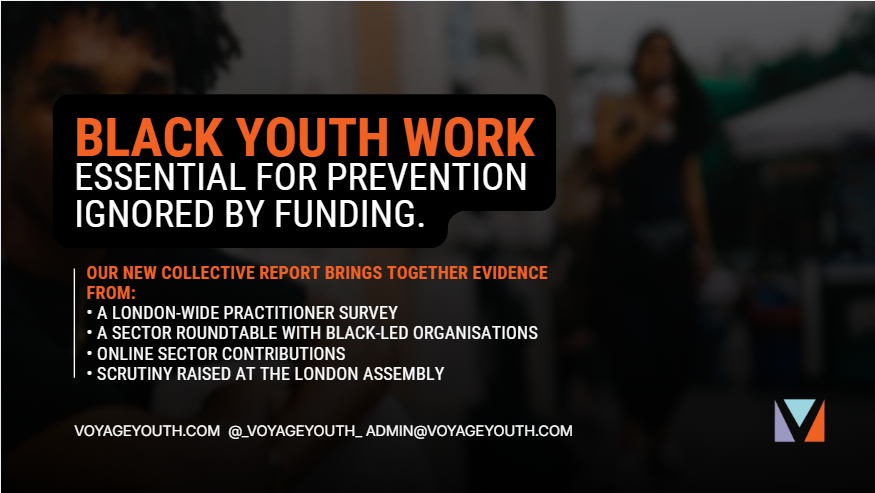
The recently published report Black Youth Work in London: Equity, Power and the Case for Collective Action, authored by Voyage CEO Paul Anderson MBE, brings together evidence from sector roundtables, practitioner surveys, online engagement and London Assembly scrutiny to examine the barriers facing Black-led youth organisations across the capital.
The report argues that Black-led youth organisations are playing a vital role in prevention and community safety while simultaneously operating within funding systems that undervalue long-term, relational and community-rooted work.
Practitioners described how current commissioning models prioritise short-term outputs and crisis intervention over the deeper preventative work happening within families and communities every day.
One of the strongest themes within the report is the idea of “360° practice” — the reality that Black youth work often extends beyond the individual young person to include parents, siblings, carers and wider community networks. The report argues that current evaluation systems frequently fail to recognise this work despite its importance in building stability, belonging and long-term safety.
The report also raises concerns around short-term funding cycles, extractive commissioning practices and the pressure organisations face to repeatedly frame their communities through trauma in order to access funding. Contributors stressed that prevention work happens over years and generations, yet many organisations are forced to operate within unstable one-to-three-year funding periods.
Alongside identifying these challenges, the report calls for collective action across the sector, including longer-term investment, fairer evaluation models, stronger protections for community knowledge and greater representation of Black-led organisations within decision-making structures.
Two recently published reports highlight many of the issues young people and youth workers have been raising for years: prevention matters, trusted relationships matter, and community-led youth work remains one of the strongest protective factors in young people’s lives.
Read the full report here
.png)
MOSAIC: Mental Health Inequalities and Young People
Voyage supported the London workshops for the MOSAIC project, a major five-year research programme led by the University of Bristol and funded by the Wellcome Trust. The project brought together young people from London, Bradford and Glasgow to explore how identity, place, discrimination, financial insecurity, culture and social pressures shape mental health outcomes for young people across the UK.
The findings strongly reflected what many young people already tell us through our work every day.
Participants spoke openly about racism, policing, gang pressures, adultification, financial stress, cultural expectations and the emotional pressure of growing up in environments where safety and opportunity are unevenly distributed. Young people also discussed the impact of social media, isolation, employment discrimination and caring responsibilities on their mental wellbeing.
A major theme running throughout the report was belonging — the importance of feeling safe, accepted and understood within schools, communities and wider society. Young people consistently highlighted how exclusion, stigma and discrimination affect confidence, identity and mental health outcomes.
Importantly, the report also reinforced the value of youth organisations and trusted adults. Across all three cities, young people described youth spaces as places where they could socialise safely, build confidence, access support and stay connected to positive opportunities. The research identifies these environments as key protective factors in preventing harm before crisis occurs.
Voyage is proud to have supported the London element of the project and to have helped ensure the experiences of young Black men and other underrepresented young people were part of a national conversation on mental health inequality and prevention.
Read the full report here
Continuing the conversation
Both reports reinforce something youth organisations across London have known for a long time: young people do best when they have stability, trusted relationships, safe spaces and communities that invest in them before crisis emerges.
At Voyage, we remain committed to creating those spaces, amplifying young people’s voices and contributing to research, partnerships and collective action that push for meaningful long-term change.
We encourage anyone interested in youth work, mental health, prevention and community-led approaches to explore both reports and join the wider conversation around what young people and communities need to thrive.